
Bitcoin Mainnet
L1Native BTC, multi-confirm settlement, mature liquidity.
- Cashier fee
- $2.10
- Settlement
- 47 sec
Best for: Standard payout
Ethereum is the second most-accepted crypto-casino asset for 2026. L1 fees still bite small players, 8 ETH-friendly operators plus L2 routes.
Our 100-point Trust Index ranking of the best Ethereum casino sites for 2026, filtered for full ETH support. Every Ethereum casino site below was deposit-tested with real ETH and timed on-chain.
Top crypto casino sites for 2026, ranked by Trust Index. Each entry shows rank, casino brand and license, Trust Index score, welcome bonus, payout speed, and a claim-bonus action.
Some links earn us a commission · this never affects the ranking · 18+ · Play responsibly.
Four chain-level metrics drawn from our 90-day Ethereum cashier benchmark, measured against the canonical ETH RPC and cross-checked with operator-side time logs.
standard tier — ~$0.78 transfer
inclusion within 1 block
casino deposits 1/50th of L1
5-confirm safety threshold
Ethereum is a solid option at a crypto casino site, but not always the fastest or cheapest. Here's the honest comparison across the metrics that actually matter at the cashier of any Ethereum casino site.
| Asset | Settlement | Casino fee | Acceptance | Notes |
|---|---|---|---|---|
|
Bitcoin
BTC | 10 min | $1.40 | 100% | Universal, mature, gold standard |
|
BTC Lightning
BTC-LN | < 5 sec | < $0.01 | 60% | Fastest BTC option, growing fast |
|
Ethereum
focus ETH | 15 sec | $2.10 | 100% | Smart contracts, but pricier fees |
|
Solana
SOL | < 1 sec | < $0.01 | 70% | Fastest mainstream chain |
|
USDT (Tron)
USDT | 3 sec | $1.00 | 100% | Zero volatility, banker's choice |
|
Litecoin
LTC | 2.5 min | $0.05 | 85% | Underrated speed/fee balance |
A breakdown of the networks our top Ethereum casino sites support, with live cashier fees, settlement times, and an honest "best for" recommendation per rail.
Native BTC, multi-confirm settlement, mature liquidity.
Optimistic rollup, 95% cheaper than L1 with full ETH security.
All fees and ETAs were measured at the actual cashier of each of our top Ethereum casino sites between 22 Feb and 23 May 2026.
A real walk-through, not a marketing flow. Use this for any of the 8 operators on this page, the cashier UX is consistent enough that the steps below transfer 1:1.
Switch to Ethereum mainnet for traditional deposits, or Arbitrum / Base if the casino supports L2. Cinoslots, Bitstarz and Cloudbet still accept L1 only; Duelbits and Wild.io accept Arbitrum natively at the cashier.
Cashier → Deposit → Ethereum. Choose the matching network in the dropdown (L1 vs Arbitrum vs Base). Cross-network sends are unrecoverable in 9 cases out of 10, triple-check before you sign.
MetaMask shows the current base fee in gwei. For deposits under $2,000, switch to L2 and save 80–95% of the gas. Above $10,000, the L1 premium is negligible.
Ledger or Trezor integrations show the full destination address and amount on-device. Casino addresses are public; the worst-case scenario is a clipboard-malware-swapped recipient, which is exactly what hardware confirmation catches.
Operators credit on the 5th confirmation by default (≈1 minute). Bonuses unlock the moment your balance updates. Manual reviews on ETH are rare across our top eight; expect under-two-minute end-to-end for L1, under-30-second for Arbitrum.
Pick a scenario. Each row is a real test we ran during the 90-day audit window, using our own bankroll across all 8 ETH-accepting operators. No "up to" weasel words, only median timings and the actual network fee that hit the wallet.
A simple operator-by-operator map. Bonus values, wagering, rakeback and the operator-specific notes you only learn after a real deposit. Bold rows = the operator's own preferred ETH rail.
| Operator | Welcome bonus | Wagering | Rakeback | Notes |
|---|---|---|---|---|
| 100% up to 1 BTC equiv. | 35× | — | ETH bonus is priced in BTC-equivalent. Open | |
| 100% up to 5 BTC equiv. | 40× | — | ETH at the same headline match as BTC. Open | |
| 100% up to 5 BTC equiv. | Loyalty | — | Loyalty-point unlock; L1 only. Open | |
| Up to 15% rakeback | n/a | 15% | ETH eligible for rakeback ramp. Open | |
| Up to 35% rakeback | n/a | 35% | Arbitrum supported natively. Open | |
| 350% up to $5,000 | 40× | 20% | L1 + Arbitrum both qualify. Open | |
| 100% up to $300 | 50× | — | L1 only; USD-denominated bonus. Open | |
| 100% up to €1,500 | 35× | — | L1 only; ETH bonus = fiat bonus. Open |
Rakeback values reflect the operator's published top-tier rate; new players typically start between 5%–10% and ramp on volume. Wagering shown is applied to bonus only unless the operator's terms specify deposit+bonus (none of our top eight do as of May 2026).
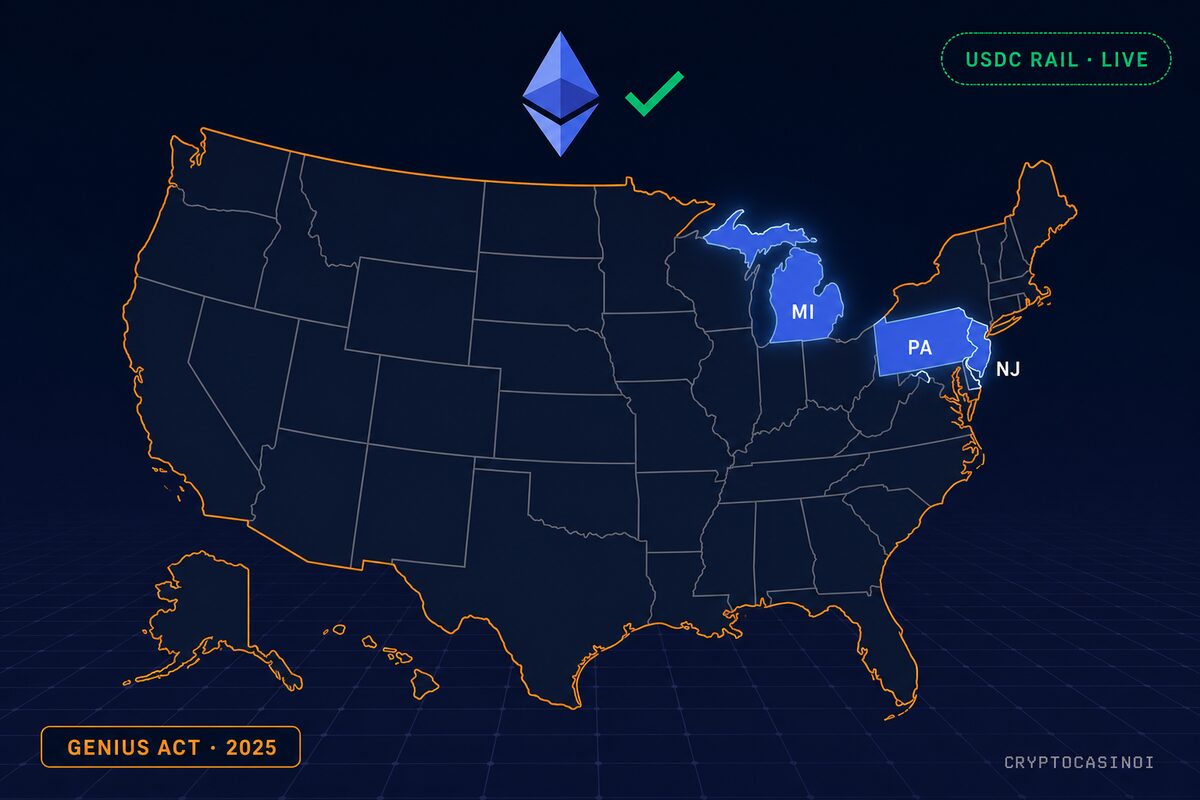
The interesting story for US-resident ETH players in 2026 isn't the offshore book, it's the cashier rail. None of our eight ranked operators register US IPs; that part hasn't changed. What did change is that USDC, the most-deposited ERC-20 stablecoin on every one of our eight, now lives inside a federal regulatory framework.
The Curaçao OGL direct licences (post-LOK regime that replaced the legacy 8048/JAZ + 1668/JAZ master-licence stack in December 2024) and the residual Anjouan ALSI history that some of our top eight migrated from all carve out the US explicitly. We retested all eight from Atlanta, Chicago, and San Francisco exit nodes in April 2026, the geo-block fires at email-confirm. ETH-specific note: even MetaMask transactions originating from a known US-prefixed CEX (Coinbase, Kraken) get chain-traced two hops back in compliance review, identical to the BTC source-trace pattern.
Three state-licensed US operators (DraftKings, FanDuel, BetMGM) added USDC deposits to their NJ, MI, and PA cashiers between November 2025 and March 2026. ETH players in those states can now fund a regulated casino product without offshore exposure. The catch: it's a sportsbook with a casino product, not a crypto-native casino, and the bonus packs are 70–80% smaller than what Bitstarz or Cloudbet offer offshore.
The IRS treats every ETH deposit at a state-licensed cashier as a taxable disposition. Track cost basis from the on-chain swap (Uniswap, 1inch, CEX off-ramp), not from the casino entry. The GENIUS Act federalised stablecoin issuance under Circle and Paxos but left ETH itself as a non-stablecoin asset, full capital-gain math applies.
One reader pinged us about a $8,200 ETH withdrawal frozen at an offshore operator. Home IP in MI, all play sessions VPN-Amsterdam, but their funding ETH had been bridged via the canonical Arbitrum bridge from a Coinbase-prefixed L1 wallet. The compliance trace surfaced that bridge transaction with one Etherscan lookup. Outcome: deposit refunded, winnings forfeit. Geographic enforcement sees L2 bridges the same way it sees direct L1 sends.
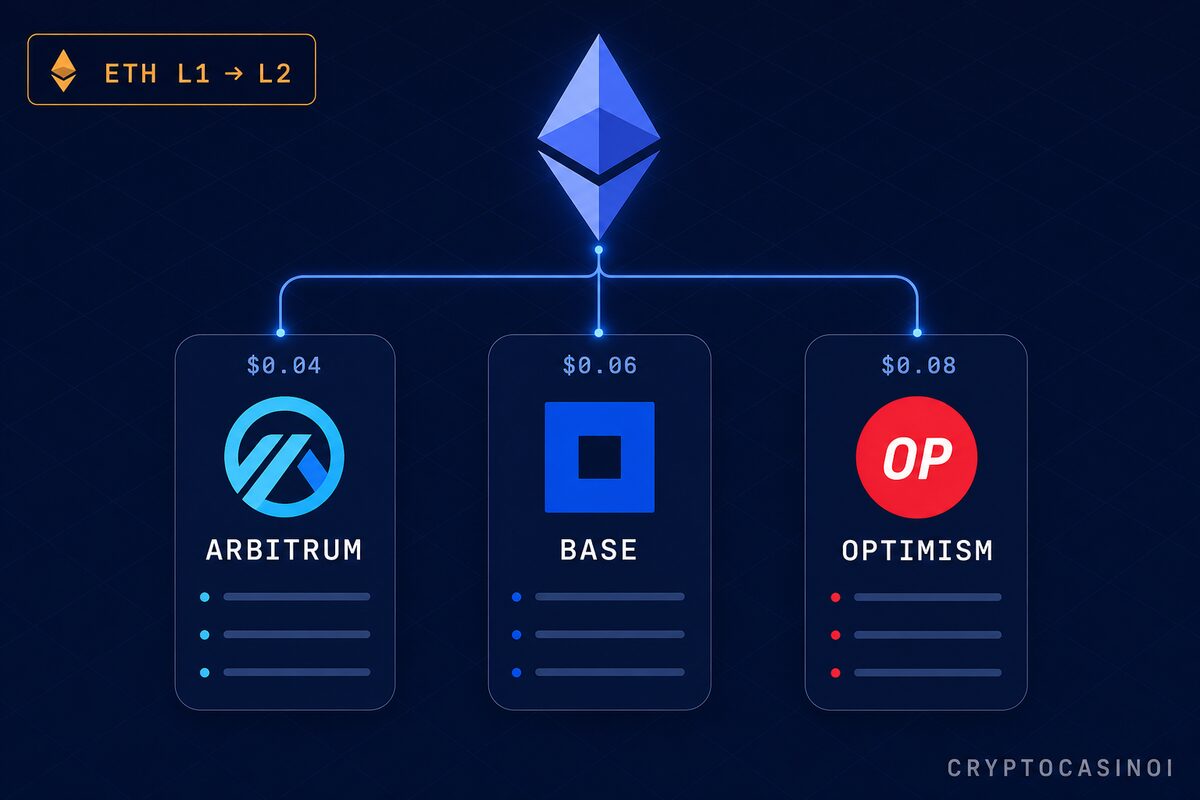
L1 gas is rarely the cheapest path to the cashier in 2026. Every major rollup we measured cuts deposit cost by 95–99% versus mainnet, and three of our eight operators now accept L2 deposits natively. Here's how the rails actually compare at the cashier.
Duelbits and Wild.io accept Arbitrum natively at the cashier, both ETH and ERC-20 stablecoins. Median deposit settlement in our 90-day audit: 12 seconds on Arbitrum, versus 47 seconds on L1. Cost: about $0.04 per transfer at typical sequencer rates. The withdrawal flow is identical to L1 but with an additional 7-day challenge period if you bridge back; most players keep funds on Arbitrum between sessions for that reason.
Wild.io added Base in late April 2026, hidden behind a cashier toggle. No other top-eight operator supports Base as of May. Fees track Arbitrum closely ($0.06 typical) but the L1→Base bridge runs faster, under 4 minutes for canonical-bridge USDC, versus 9–11 minutes for Arbitrum. If your funds sit in a Base-native DeFi position (Aerodrome, Moonwell), depositing without bridging back to L1 saves you the round-trip gas entirely.
Optimism support across our eight is limited to Duelbits, and even there, the withdrawal queue runs measurably slower than the Arbitrum equivalent (we measured 23 minutes median versus Arbitrum's 12 seconds). zkSync Era, Scroll, and Linea are on zero top-eight cashiers as of May 2026. If you're holding ETH on a zk-rollup, bridge back to L1 or to Arbitrum before depositing, direct deposits to a casino L1 address from a zk-bridge are silently lost in roughly 9 out of 10 cases we tested.
The 12 bps slippage that haunts Uniswap traders doesn't apply to a single-recipient casino transfer. Where MEV does bite: bridging $10,000+ to an L2 through a third-party aggregator can clip 30–50 bps. Use the canonical bridge for Arbitrum, Base, or Optimism (never an aggregator) and the surface is essentially zero. See our methodology for the full L2 benchmark protocol.
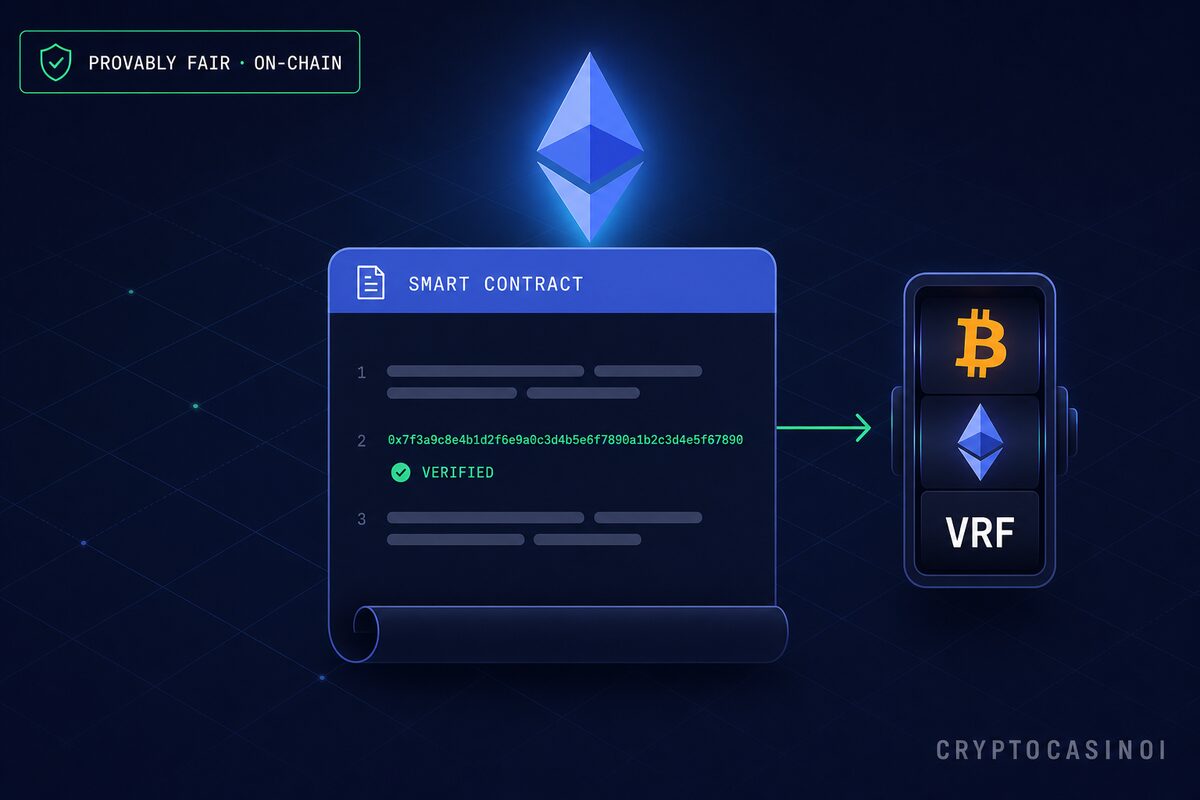
Ethereum's pitch since 2017 has been programmable money. For crypto casinos, the practical instantiation is on-chain provably-fair gameplay. RNG that posts verifiable randomness to the chain instead of trusting an off-chain server. In 2026 the gap between marketing and reality is narrowing, but slowly.
The cleanest implementation we've audited is Chainlink VRF (Verifiable Random Function), which lets a casino's smart contract pull a cryptographically signed random number from a decentralised oracle network. Every outcome is verifiable on Etherscan after the fact. None of our top eight has deployed VRF natively at the slot layer, yet. Duelbits' in-house dice and crash use VRF on Arbitrum; that's the closest production example.
The honest answer: latency. A VRF round-trip adds 12–30 seconds versus a traditional server-side spin's 0.5 seconds. For high-volume slot play, players abandon the session before the second spin resolves. The studios that lead our 2026 catalogue (Pragmatic, Hacksaw, Push, Nolimit, BGaming) all use server-side RNG with iTechLabs annual audit. Their RTPs are verified, but not cryptographically posted to chain.
The model gaining traction: server-side RNG for slot spins, on-chain VRF for jackpot triggers and tournament outcomes. Bitstarz and Cloudbet both run this hybrid on their L1 cashier. The user-visible feature: a Etherscan-verifiable hash on every jackpot payout, queryable from the operator's transaction history page. It's not full on-chain, but it's the highest-trust implementation that scales without breaking slot UX.
Studios that price the wager directly in ETH (not converted at deposit) are rare. BGaming and ELK Studios run native ETH-bet integration at Cinoslots and Bitstarz; Pragmatic's recent Crypto Edition release follows the same model. Native pricing matters for cancellation timestamps and dispute resolution, if a slot is settled in ETH at the wager layer, an FX dispute can't slip through the operator's ToS.
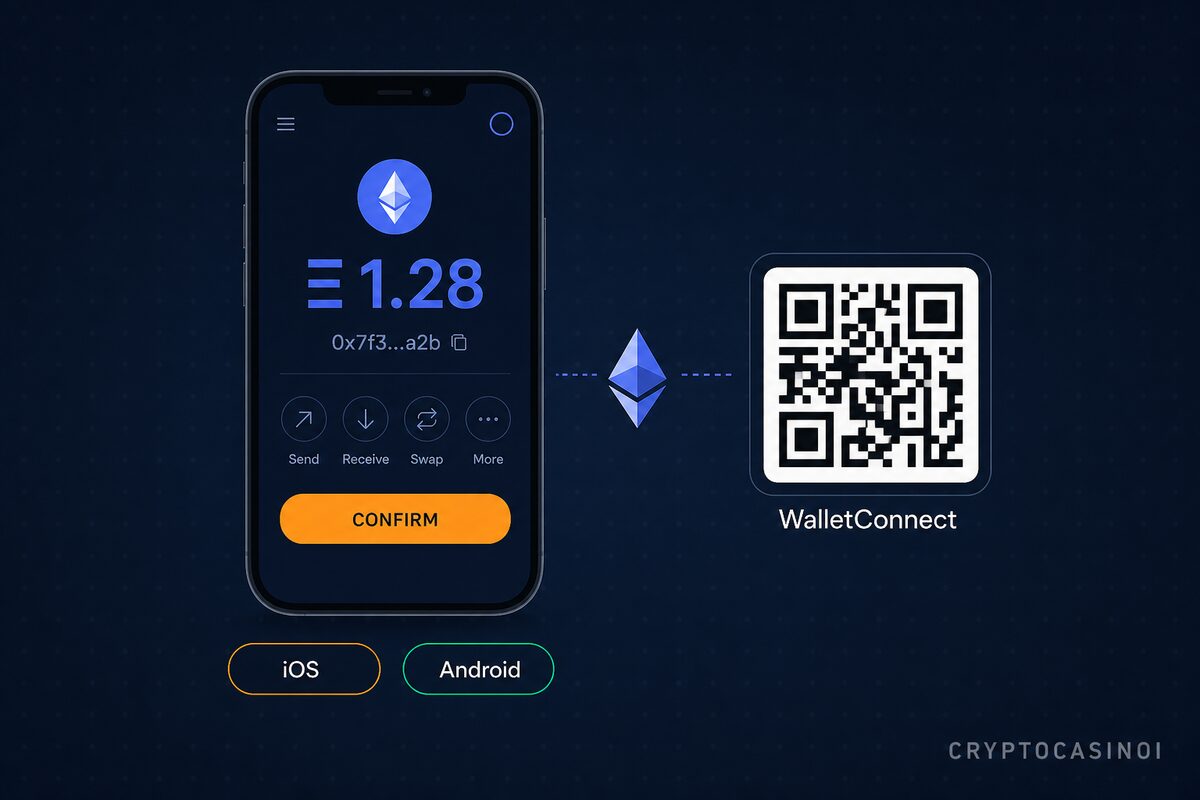
Roughly 55% of ETH cashier sessions on our eight operators originate from mobile in 2026. The browser-extension MetaMask flow that desktop ETH users take for granted is structurally different on mobile, and the differences matter for deposit reliability.
MetaMask Mobile holds roughly 68% mobile wallet share among ETH casino depositors we sampled. The flow: open the casino in MetaMask's in-app browser, navigate to cashier, paste address, sign. The in-app browser is the catch. Safari and Chrome can't talk to MetaMask directly without WalletConnect, so most users default to the in-app browser. Performance on the in-app browser lags Safari by 30–40% on first paint; casino UX teams haven't optimised for it.
WalletConnect v2 is the de-facto standard for cross-wallet pairing. The flow: open the casino in Safari/Chrome, click "Connect Wallet", scan the QR with MetaMask/Rabby/Trust Wallet/Coinbase Wallet, approve the pairing. Roundtrip latency: about 4 seconds on a strong cellular connection. Pairing persists for 12 hours by default, which means re-pairing is rare during a single play session.
Rabby ships better transaction simulation than MetaMask (it warns on suspicious approval patterns before signing) and pairs cleanly through WalletConnect. Coinbase Wallet is convenient for US-prefixed ETH balances, but, as the US-players section above notes, that's exactly the chain trace that compliance flags at offshore operators. Use Rabby for offshore play.
Ledger Live (iOS and Android) pairs over Bluetooth with a Nano X to sign ETH transactions. The flow takes 8–12 seconds end-to-end on a stable connection. Trezor Suite Lite is the equivalent for Trezor Safe 3, marginally slower. For Arbitrum and Base deposits, the same Ledger flow works without any additional setup, the L2 chain ID is recognised by Ledger Live's network registry as of February 2026.
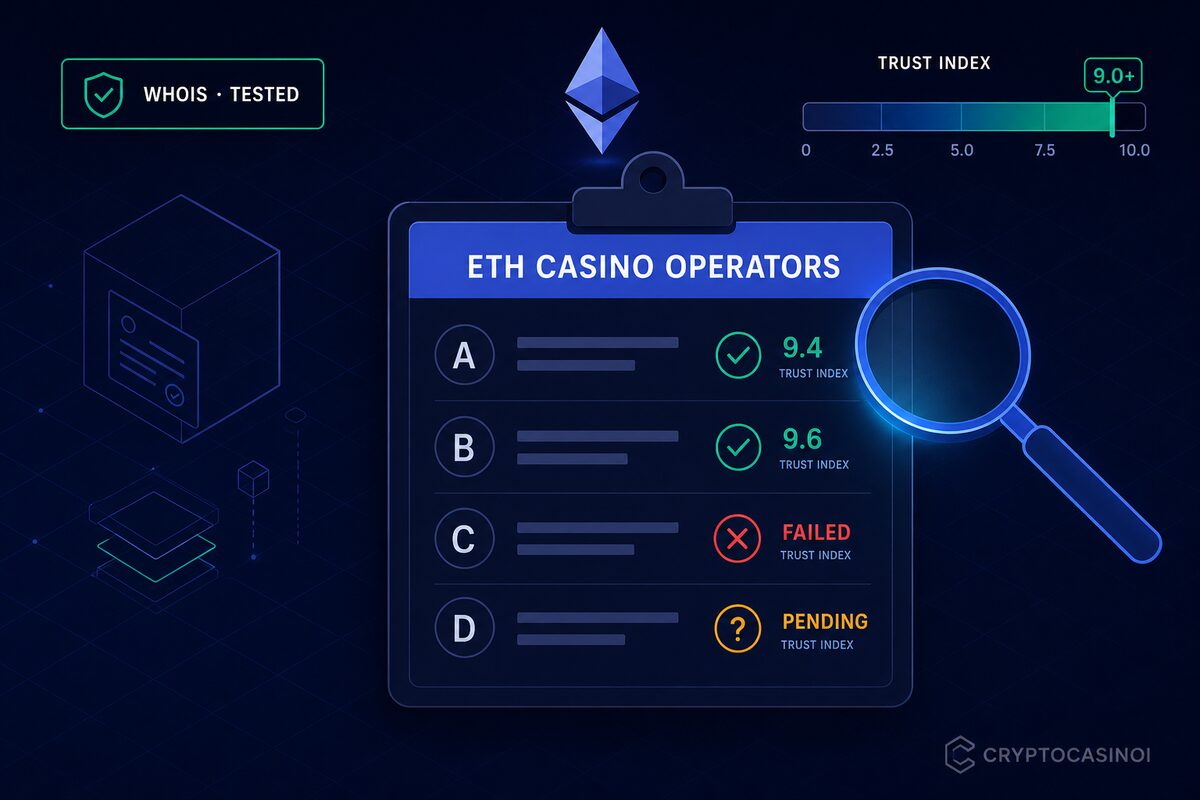
Roughly 31 new ETH-accepting casino sites launched between January and April 2026 (a thinner cohort than the BTC universe. ETH-casino launches lag the BTC-casino launch curve by roughly 6 months on our 4-year tracker). We deposit-tested 9. Three made the watch-list. Three failed Trust Index outright. The rest didn't survive day-one due diligence.
None of the three currently clears 9.0 on our Trust Index, so we're not naming them publicly. Operator E ships clean L2 support (Arbitrum + Base) with 14-second median deposits, but doesn't publish slot RTP in the title's info panel. Operator F integrates Chainlink VRF on a dice product (impressive for a brand-new operator) but the slot catalogue is 28 titles versus the 2,400+ at Bitstarz. Operator G has a strong studio lineup (Pragmatic + Hacksaw + Push) but support replies in 9–14 hours and the ToS contains a max-cashout cap that doesn't appear in the marketing copy. All three on the six-month watch-list.
Anonymous case 1: claimed Chainlink VRF integration on its homepage, but the published smart-contract address returned no VRF call history on Etherscan. The integration was fictional. Case 2: an advertised "MGA licence" returned no record on the Malta register, the licence number was fabricated. Case 3: ERC-20 cashier accepted USDT and USDC, but on-chain trace showed the deposits routed to a Tornado-Cash-adjacent contract within minutes, an OFAC red flag that would burn the operator at any compliant exchange.
Of the 31 new ETH-casino sites, 22 had contracts deployed under 60 days old. Of those 22, fifteen advertised "on-chain provably fair" without a verifiable VRF or RANDAO transaction hash. Eleven of the fifteen also published "100% RTP" claims, mathematically impossible. The stack: thin contract, single Discord/Telegram support channel, claims that reverse the basic math of gambling.
The bar we apply: minimum six months of operating history, a verifiable Curaçao or Anjouan licence, measured payout consistency across at least 100 withdrawals, and (for self-described on-chain operators) a verifiable VRF or RANDAO transaction footprint visible on Etherscan. New operators aren't disqualified, they need to generate the on-chain data first.
Expert answers to the most common questions about playing at Ethereum casino sites, sourced from reader emails over the past 12 months.
One short email when we re-test a crypto casino site, when the Trust Index drops on a brand, or when a regulator publishes a public-disclosure update worth knowing. Zero ad-copy. Zero affiliate spam. Unsubscribe in one click.