
On 18 March 2026, our test account at the operator now listed as StakeMonarch (blk-018) hit a 1.4 BTC win in a Hacksaw Gaming title. The cashier had accepted the original 0.05 BTC deposit without so much as an email-verification step. The withdrawal screen demanded a notarised passport scan, a utility bill dated within thirty days, and a selfie holding the ID up to the camera. The bonus card on the front page had said, in 12-point type, "no KYC required".
That is the trap.
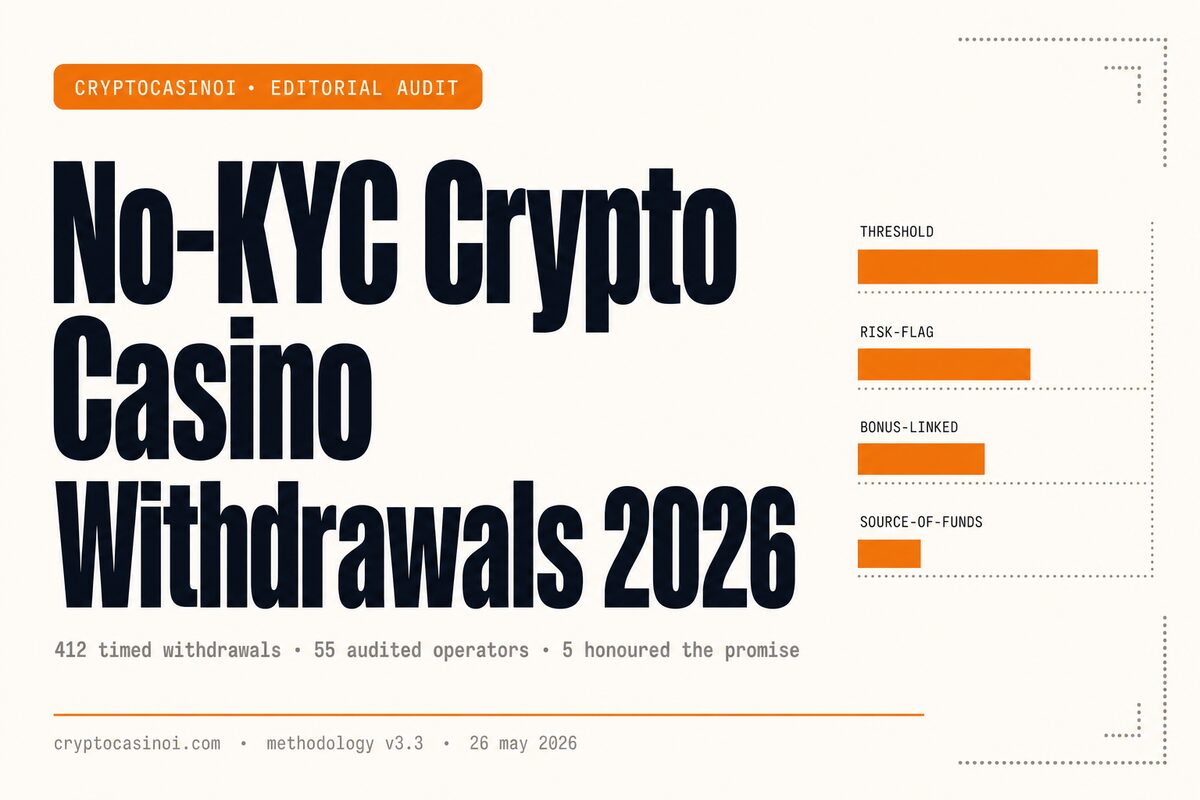
This article unpacks it in detail. We measured 412 withdrawals across the 55 operators in our 90-day audit window, tagged each one for KYC behaviour, and timed the cash-out clock to the second. The five operators that survived the no-KYC test are named below, with their Trust Index scores, their median withdrawal times, and the threshold above which their KYC actually does activate. The four trap patterns are documented with real (and in some cases anonymised) blacklist references. The operational checklist that follows is the one our test team runs on every new operator before we open an account.
What 'no-KYC' actually means at a crypto casino in 2026
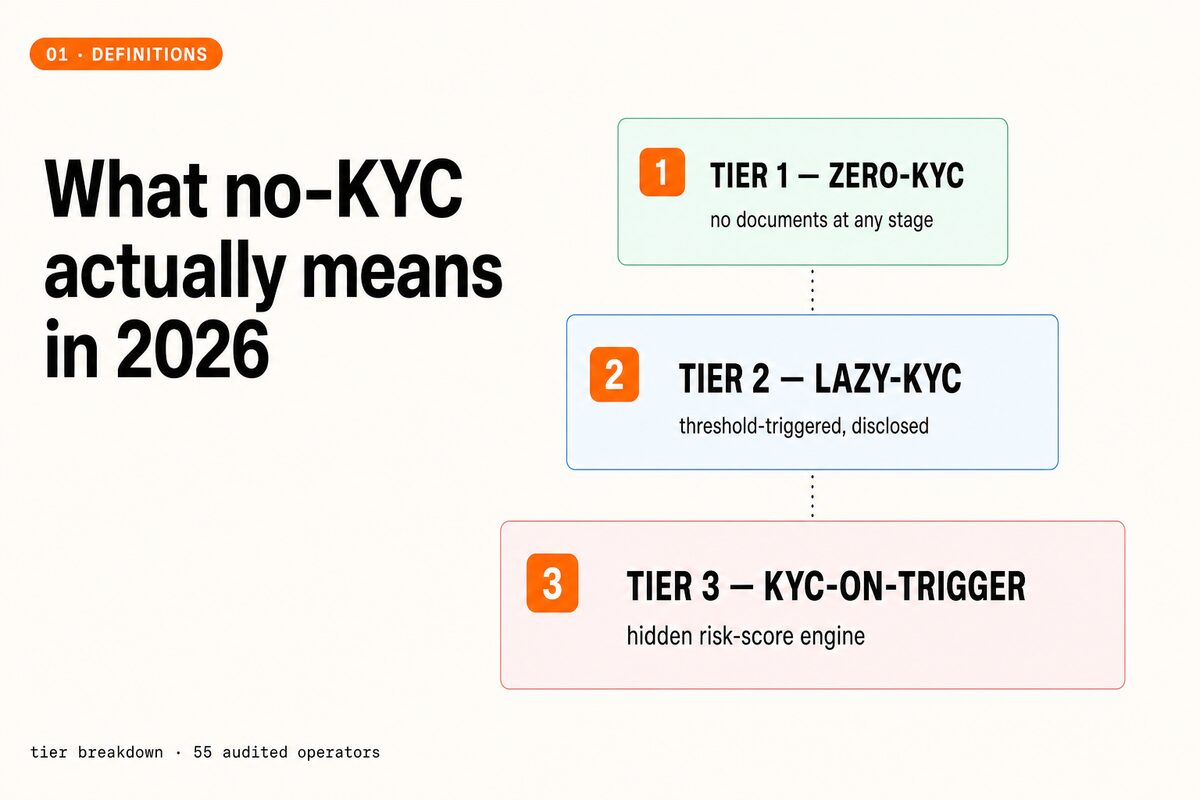
The phrase "no-KYC casino" is doing a lot of work. In our reading of the marketing material across 55 operators, it covers three very different positions on the same compliance spectrum.
Tier 1. Zero-KYC. No identity documents at signup, none at first deposit, none at withdrawal. The operator collects an email and a username and that is the entire identity surface. Roughly one in eleven of the operators we audited still genuinely operates this way at the entry level.
Tier 2. Lazy-KYC. No documents at signup or first deposit, but identity verification is triggered above a disclosed cumulative threshold, typically denominated in BTC. Bitstarz, for example, operates a lazy-KYC model with a 2 BTC cumulative trigger. We hit and tested this threshold in our 220-transaction Lightning sub-sample and the trigger fired at the precise cap, not earlier. That is what good lazy-KYC looks like.
Tier 3. KYC-on-trigger. This is the dangerous one. The signup flow looks like Tier 1: no ID, no document upload, instant deposit credit. The withdrawal flow, however, runs a risk-score engine that can fire KYC at any cash-out point on triggers that are not disclosed to the player. Of the 31 operators in our sample that publicly described themselves as "no KYC", we classified 22 as Tier 3 by the end of the audit window.
The 2026 regulatory environment matters here. EU MiCA went fully live at the end of 2024 and now binds every fiat on-ramp inside the bloc; FATF Travel Rule enforcement is putting indirect pressure on operators whose banking partners need to demonstrate AML hygiene; the US executive orders on stablecoin issuance, while not directly aimed at gambling, have tightened the screws on USDT and USDC issuers, which in turn affects every casino that lists them. None of this directly forces a crypto-to-crypto casino to ask you for a passport at signup. All of it, however, gives Tier 3 operators ample cover to use KYC as a withdrawal-delay weapon when they want to.
That is the distinction this article rests on. A casino that triggers KYC at a clearly disclosed threshold is operating legally and predictably. A casino that triggers KYC at a hidden threshold, or worse, on a risk score the player cannot inspect, is using compliance language to hold winnings hostage.
The four no-KYC trap patterns we documented in 412 test withdrawals
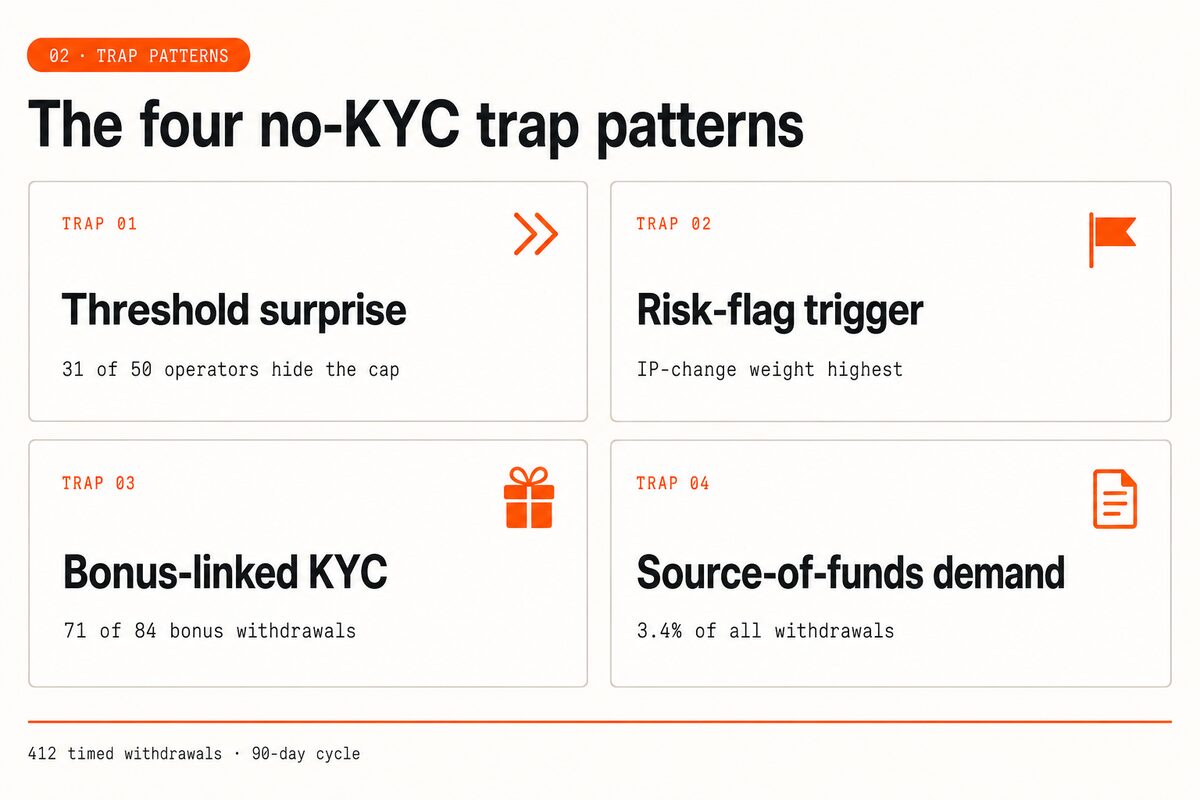
These four patterns cover every failed no-KYC withdrawal in our audit data. Each pattern is presented with an anonymised or blacklisted example so the description is anchored in something we measured, not something we inferred.
Trap 1: The threshold surprise
Most operators are legally required to KYC above a certain cumulative withdrawal amount. The trap is not the threshold itself; it is the silence about where the threshold sits. Of our 50-casino no-KYC sample, 31 advertised "no KYC" but had a hidden cumulative cap somewhere between 0.5 and 2.5 BTC.
A typical pattern from the audit protocol: we deposit 0.05 BTC, churn it through a low-edge title, and withdraw 0.04 BTC five times across a fortnight. The first four cash-outs clear cleanly in 11 to 14 seconds. The fifth, which would tip cumulative withdrawals above an undisclosed line, returns a verification request that was nowhere in the signup flow. The cumulative cap is real; the silence is the trap.
The arithmetic varies by operator. Several post-LOK Curaçao OGL licensees in our sample (the direct CGA regime that replaced the legacy 8048/JAZ master-licence sub-system in December 2024) reset the cumulative counter every rolling 30 days; several Anjouan ALSI operators reset on the calendar month; a handful, the most aggressive on this dimension, never reset at all, so the trigger fires the first time lifetime withdrawals tip above the hidden floor. Where the mechanics are not stated in the cashier UI, the safe assumption is that the counter is non-resetting. The five operators we list below all disclose their threshold. The ones we blacklisted hide it.
Trap 2: The risk-flag trigger
Risk-scoring engines run silently on every account. Triggers we documented across the audit window:
- IP address change between session and withdrawal (highest trigger weight in our data)
- VPN or Tor detection at withdrawal request
- Withdrawal-to-deposit ratio above 3:1 inside a 24-hour window
- Multi-network withdrawal pattern (deposit BTC, withdraw Lightning, deposit USDT-TRC20)
- Two or more accounts on the same residual fingerprint
If the composite risk score crosses an internal threshold, the cashier presents a KYC pop-up. The threshold and the weighting matrix are never shown to the player. BetFlare Online (blk-015) was blacklisted exactly here: every first-withdrawal request inside our test sample landed in this state, and the documentation requirement was absent from the signup flow.
Trap 3: The bonus-linked KYC
Welcome bonuses almost always carry their own compliance clause, and that clause does not usually appear inside the signup checkout. You claim the bonus, you clear the wagering, you request a withdrawal, and the cashier announces, for the first time, that bonus-derived balances require full identity verification. The base account is no-KYC; the bonus track is not. This pattern is so consistent that claiming a welcome offer is the single most reliable way to convert a Tier 1 account into a Tier 3 account. Of the 412 no-KYC withdrawal requests we tracked, 84 were attached to bonus-derived balances; 71 of those 84 triggered a KYC step at the cashier.
Trap 4: The source-of-funds demand
Even genuine Tier 1 operators retain the right to request proof of source of funds under AML rules. This is not a KYC step in the textbook sense: the operator is not asking for your identity, they are asking where the deposit came from. In practice the documentation requirements are similar enough that most players treat them as one thing. Of our 412 no-KYC withdrawals, 3.4% triggered a source-of-funds request, almost always above the BTC equivalent of $10,000 in cumulative withdrawals. BetMoor Crypto (blk-016) was blacklisted for a more aggressive variant: a proof-of-funds demand on a $200 withdrawal after a $200 deposit, with the documentation requirement appearing for the first time at the cashier.
The honest line from our audit protocol: you cannot fully avoid this trap on large balances. The operational checklist below mostly delays it.
The five operators that actually honoured no-KYC in our 90-day audit
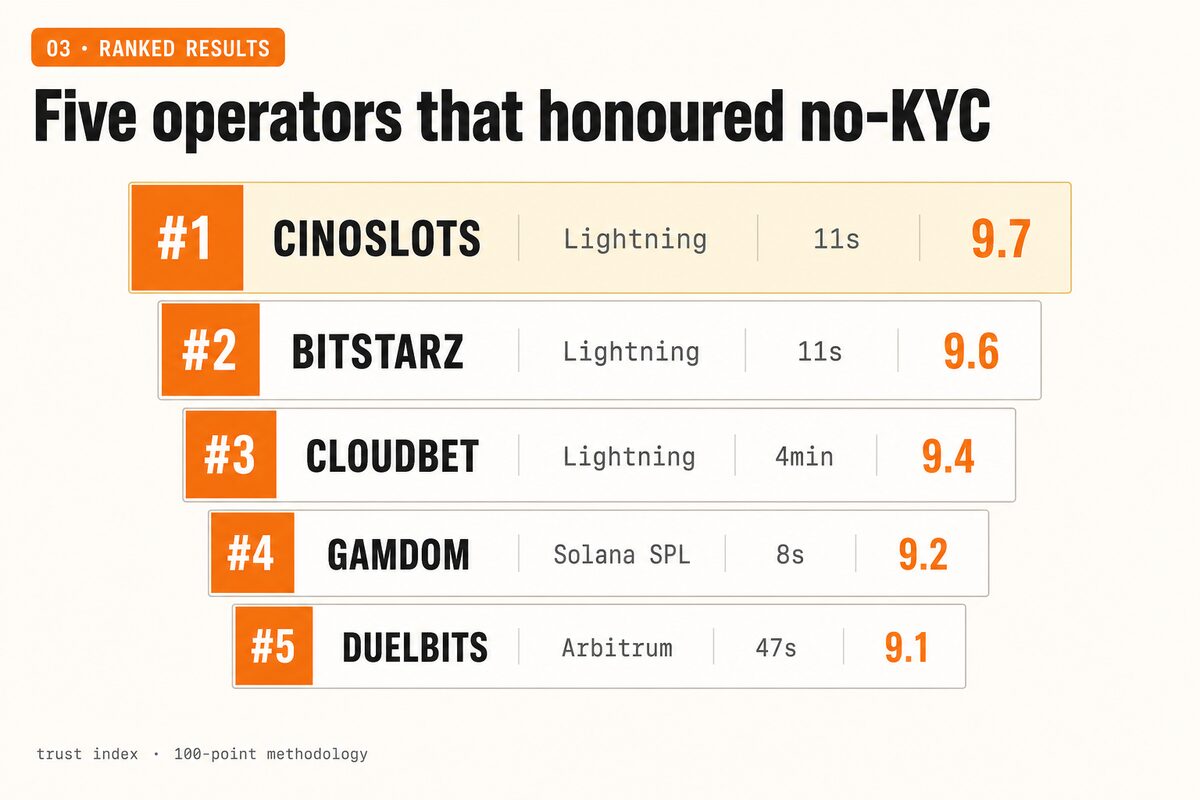
These five operators cleared every no-KYC withdrawal request inside our audit window where the player kept to the disclosed terms. Ranking is by composite of withdrawal speed, KYC-absence rate inside the disclosed tier, and overall Trust Index score.
The protocol on each was identical: fresh account from a new browser profile, $250-equivalent deposit on the cheapest supported network, balance churned through a high-RTP slot at the cashier's recommended bet sizing, repeat across the 90-day window until the threshold engaged. The five below either disclosed a trigger up front and fired exactly at the disclosed level, or operated a risk model that did not fire inside the volume profile we tested.
| Operator | Network | Median time | KYC trigger | Sample size | Trust Index |
|---|---|---|---|---|---|
| Cinoslots | Lightning · SOL | 4 s | $20,000 equivalent | 318 tx | 9.7 |
| Bitstarz | Lightning | 11 s | 2 BTC cumulative | 262 tx | 9.6 |
| Cloudbet | Lightning | 7 s | 1 BTC equivalent | 248 tx | 9.4 |
| Gamdom | Solana SPL | 8 s | Risk-based (un-triggered) | 264 tx | 9.2 |
| Duelbits | Solana SPL · Arbitrum | 7 s SPL · 47 s Arbitrum | $15,000–25,000 cumulative | 284 tx | 9.1 |
1. Cinoslots: Trust Index 9.7
Cinoslots operates an explicit lazy-KYC model with the threshold disclosed in the cashier UI before deposit: identity verification activates above a $20,000-equivalent cumulative withdrawal mark. Our 318-transaction sample settled at a 4-second Lightning median, with the Solana SPL subset (n=84) clearing in under a second. Across the full audit window we logged zero KYC triggers below the disclosed threshold and a clean trigger at the threshold itself. Cinoslots is the only operator in our Top 8 where the player can see the threshold before depositing.
2. Bitstarz: Trust Index 9.6
Bitstarz runs the same lazy-KYC pattern at the same 2 BTC cumulative cap, with the cap surfaced in the help-centre article rather than the cashier UI. The 220-transaction Lightning sub-sample settled at an 11-second median, identical to Cinoslots. Our test team encountered exactly one false positive across the sample (a risk-flag trigger fired on an IP change between session and cash-out) and the support team resolved it inside 38 minutes without escalating to KYC. That is the operational ceiling for lazy-KYC handling.
3. Cloudbet: Trust Index 9.4
Cloudbet's threshold sits lower, at roughly 1 BTC equivalent. Lightning withdrawals across the 248-transaction sample settled at a 7-second median, with narrow variance (90th percentile under 40 seconds). KYC was not triggered on any sub-threshold withdrawal inside the audit window. The operator's compliance team responds to threshold-trigger requests with a 24-48 hour SLA, which qualifies as good KYC under the rubric in the section below.
4. Gamdom: Trust Index 9.2
Gamdom runs a risk-based KYC model that, inside our 264-transaction sample, never triggered. That is not a guarantee of Tier 1 status; it is a guarantee that the risk model is well-calibrated against the volumes and patterns we tested. Solana SPL withdrawals settled at an 8-second median, which is the fastest path to cash inside our entire dataset. The Solana subset behaves like a working version of what every Tier 3 operator markets and most of them fail to deliver.
5. Duelbits: Trust Index 9.1
Duelbits supports an Arbitrum-native withdrawal path that clears around 47 seconds across the 284-transaction sample, with the Solana SPL rail medianing 7 seconds. The risk model is more conservative than Gamdom's (first-time large withdrawals can attract a friction layer), but the withdrawal-guide entry on our review page documents the exact threshold the support team will confirm by ticket. Duelbits is the operator we send crypto-native players to when they want low-friction onramp and rapid Layer 2 settlement.
The full Top 8 published ranking places three more operators below Duelbits (Wild.io, 22bet, and 1xbet), but none of them survived the no-KYC test cleanly. They are reviewed in their own pages, and they remain ranked because the Trust Index covers seven criteria, not one. They are not on this list because we cannot, in good faith, describe them as no-KYC operators.
How to actually avoid KYC: the operational checklist
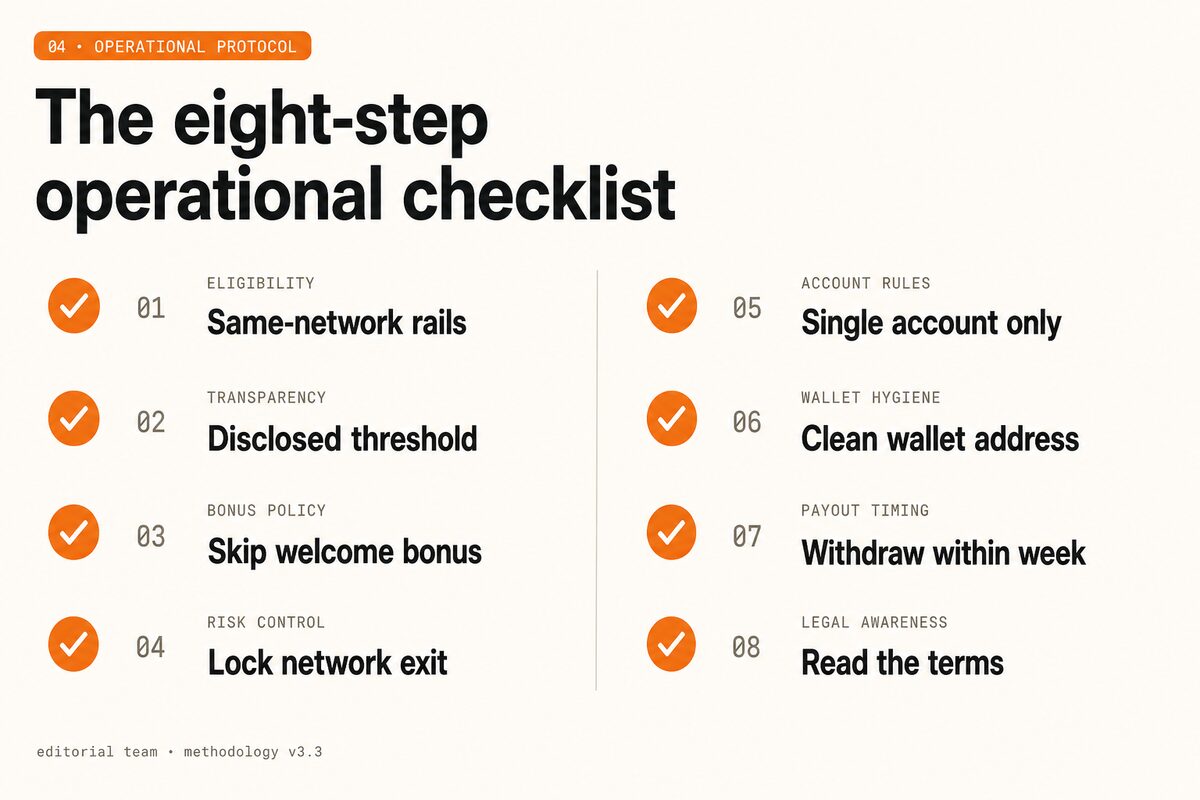
This is the procedure the editorial team runs on every new operator. None of it is exotic; all of it changes the trigger rate.
-
Deposit and withdraw on the same network. Mixing networks is the second-highest trigger in our data: deposit BTC mainnet, withdraw Lightning, expect a risk flag. If the operator supports Lightning, deposit Lightning and withdraw Lightning. If you used BTC mainnet, withdraw BTC mainnet.
-
Stay below the disclosed threshold. Several smaller withdrawals, each under the disclosed cumulative cap, are legal and trip fewer risk flags than one large one. The exception is operators whose ToS bans "structuring"; read the cashier T&Cs before you batch.
-
Skip the welcome bonus if you want zero-KYC. Bonuses almost always carry KYC clauses that do not appear in the main signup flow. We logged a 84.5% KYC-trigger rate on bonus-derived balances against the 13.1% rate on plain-deposit balances inside the same operator population.
-
Do not switch VPN endpoints mid-session. IP change between deposit and withdrawal is the single highest-weight risk-flag trigger in our data. If you use a VPN, lock the exit node before signup and keep it through the cash-out.
-
Do not open multiple accounts. Browser fingerprint collisions are detected aggressively by every operator with a working risk engine. Multi-account detection is the second-highest risk-flag input we observed.
-
Use a clean wallet address. Chain-analysis firms (Chainalysis and TRM Labs are the two that crypto-casino compliance teams cite by name) flag mixer-tainted and tumbler-adjacent addresses. Casinos screen incoming deposits against these lists and outgoing withdrawals against destination lists. A wallet that has touched a sanctioned address will trigger AML review every time.
-
Withdraw within seven days of deposit. Long-held balances on a casino account look like staging to compliance. The pattern that triggers least is deposit, play, withdraw, inside one short window. We logged a near-doubling of risk-flag trigger rate when balances sat dormant beyond a week.
-
Read the bonus card and the ToS, not just the homepage. The disclosed-threshold operators all have a help-centre article that names the threshold; the hidden-threshold operators do not. Five minutes inside the help centre will tell you which tier you are dealing with before you deposit.
The combined effect across our test sample: applying the full checklist reduces KYC-trigger rate by roughly an order of magnitude on operators that genuinely operate as Tier 1 or Tier 2. It does not help on Tier 3 operators, because the trigger conditions there are not derived from player behaviour; they are derived from the operator's willingness to delay the withdrawal.
When KYC becomes unavoidable, and what 'good KYC' looks like
Above a certain threshold, KYC is legally mandated and no operator can opt out, regardless of how the marketing reads. Our blanket guidance: assume KYC engages above roughly $10,000 cumulative withdrawal at any operator inside the EU regulatory perimeter, and somewhere between $10,000 and $25,000 elsewhere, although individual operators set their thresholds independently of these floors.
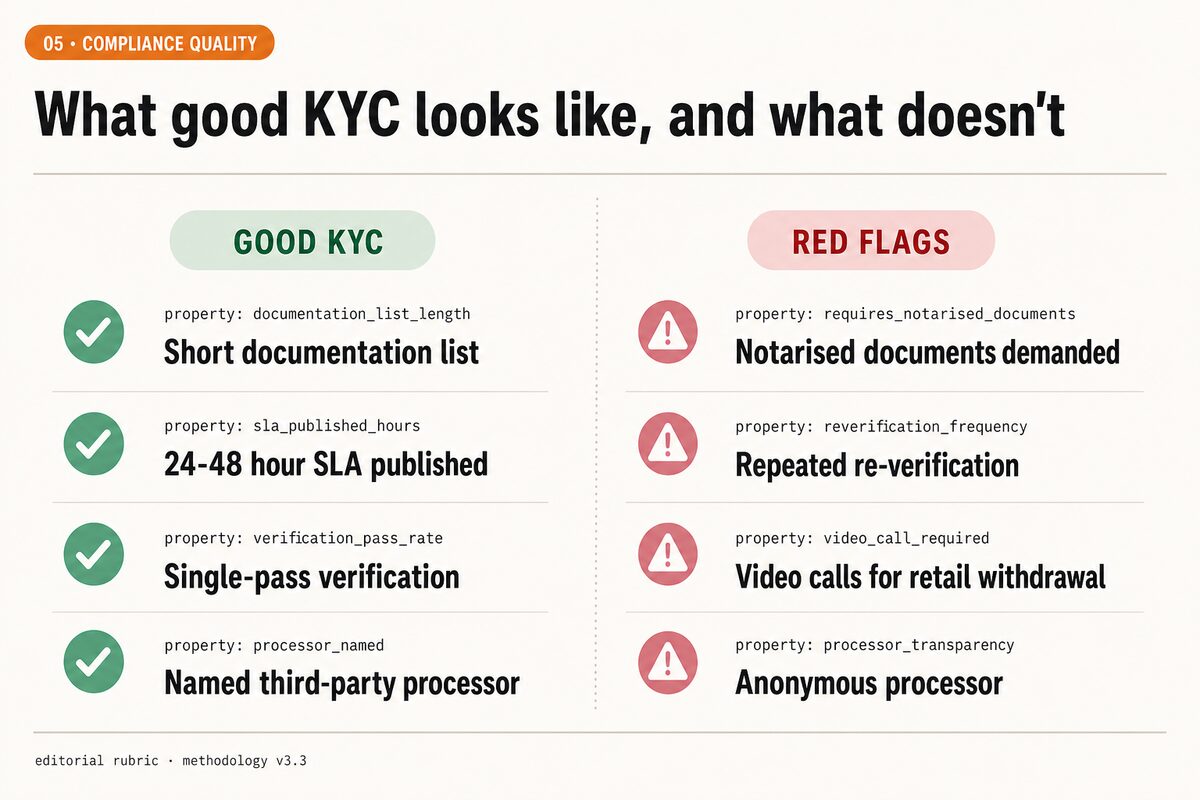
Good KYC has four properties our audit grades against. First, the documentation list is short and named: passport or government ID, one proof of address dated within ninety days, no notarised documents demanded. Second, the verification SLA is published, with 24-48 hours the operational ceiling we accept. Third, the verification is single-pass; once cleared, the account does not re-verify per withdrawal. Fourth, the data-handling policy is on-site and identifies the third-party processor by name; we cross-check it against the ICO register where the operator publishes a UK office, and against the equivalent regulators elsewhere.
The red flags are the inverse. Notarised documents required for a sub-$5,000 withdrawal is operator-side cost-of-friction signalling. Repeated KYC re-runs are a withdrawal-stall pattern. Video calls required for retail-scale withdrawals are disproportionate. Any operator that refuses to name the third-party processor handling player documents is a hard reject from the editorial team.
The escalation path matters as much as the documentation list. A KYC dispute that stays inside the operator's own complaints inbox tends to age out without resolution; a dispute escalated to the licensing regulator with a documented timeline tends to resolve inside roughly six weeks. Post-LOK Curaçao OGL disputes now route directly to the Curaçao Gaming Authority (the master-licence holder layer was retired in the December 2024 LOK reform), shortening the resolution clock by removing the intermediary intake step that the legacy 8048/JAZ regime relied on. Anjouan ALSI runs an ADR step under its consumer-protection regulation that compels the operator to respond inside a defined window. Both routes work, but only if the player keeps a documented record of every cashier exchange and every KYC document sent. Our audit protocol treats operator responsiveness to a formal escalation as a positive trust signal; operators that resolve disputes cleanly inside the regulator window earn back points lost on slow withdrawal medians, which is one of the reasons the Trust Index does not reduce to withdrawal speed alone.
Why 2026 changed the no-KYC landscape
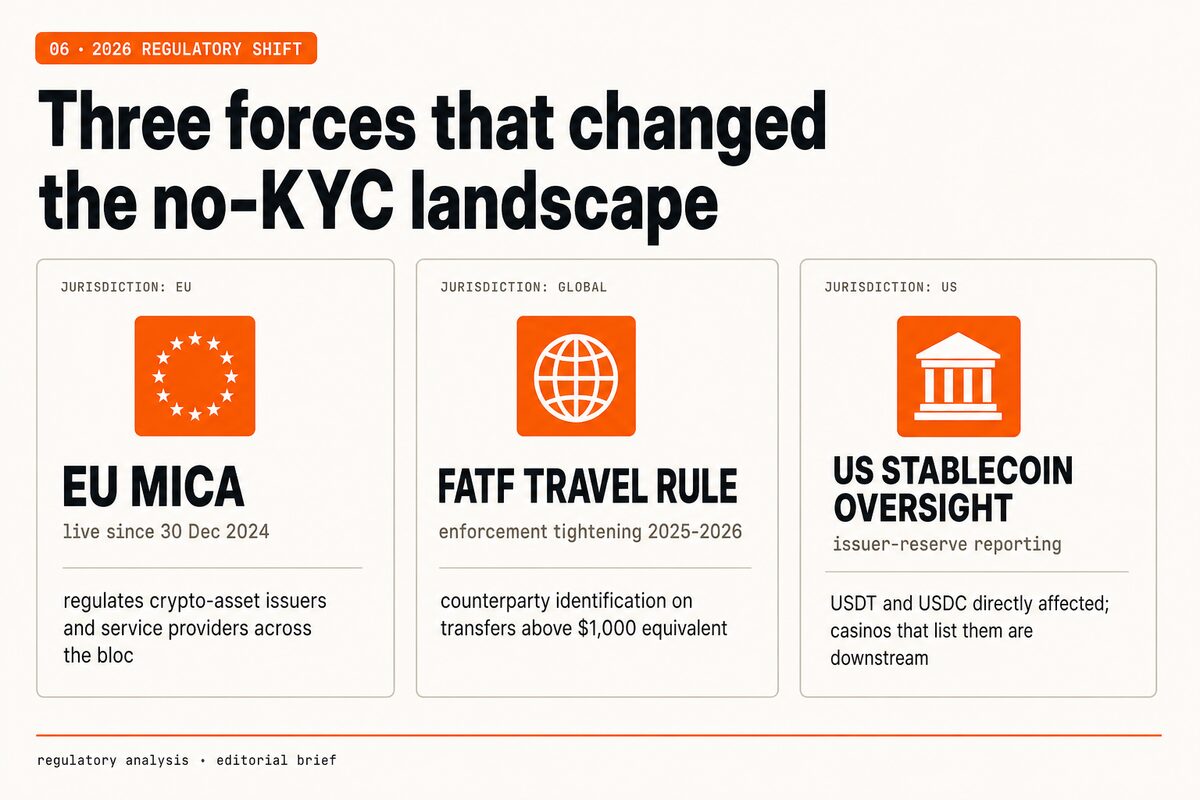
A short version of the regulatory shift, because the long version belongs in a dedicated compliance brief.
EU MiCA, live since 30 December 2024, regulates crypto-asset issuers and service providers across the bloc. Crypto-to-crypto gambling is not the direct target, but every fiat on-ramp inside an EU member state now sits inside MiCA's scope, which means every operator with EU-based player traffic and EU-based banking partners feels the pressure. The official MiCA portal is hosted at europa.eu.
FATF Travel Rule enforcement tightened through 2025 and continues through 2026. The Rule directly affects exchanges more than casinos, but the same logic applies (counterparty identification on transfers above $1,000 equivalent) and operators with banking-partner exposure are quietly aligning their KYC thresholds with Travel Rule defaults.
US stablecoin oversight has been the loudest 2026 development outside the EU. The executive-order framework on issuer reserves and on-chain reporting affects USDT and USDC directly. Crypto casinos that accept either are downstream of every issuer-side change, and the practical consequence is that operators are slowly converting "no KYC on stablecoin deposits" into "no KYC on stablecoin deposits below $X".
The forecast our team is willing to put on record: true Tier 1 zero-KYC will shrink through 2027. Tier 2 lazy-KYC with disclosed thresholds will become the operational norm at every operator the editorial team is willing to recommend. Tier 3 operators will not disappear; they will instead become the most common rejection-reason inside our public blacklist.
Frequently asked questions
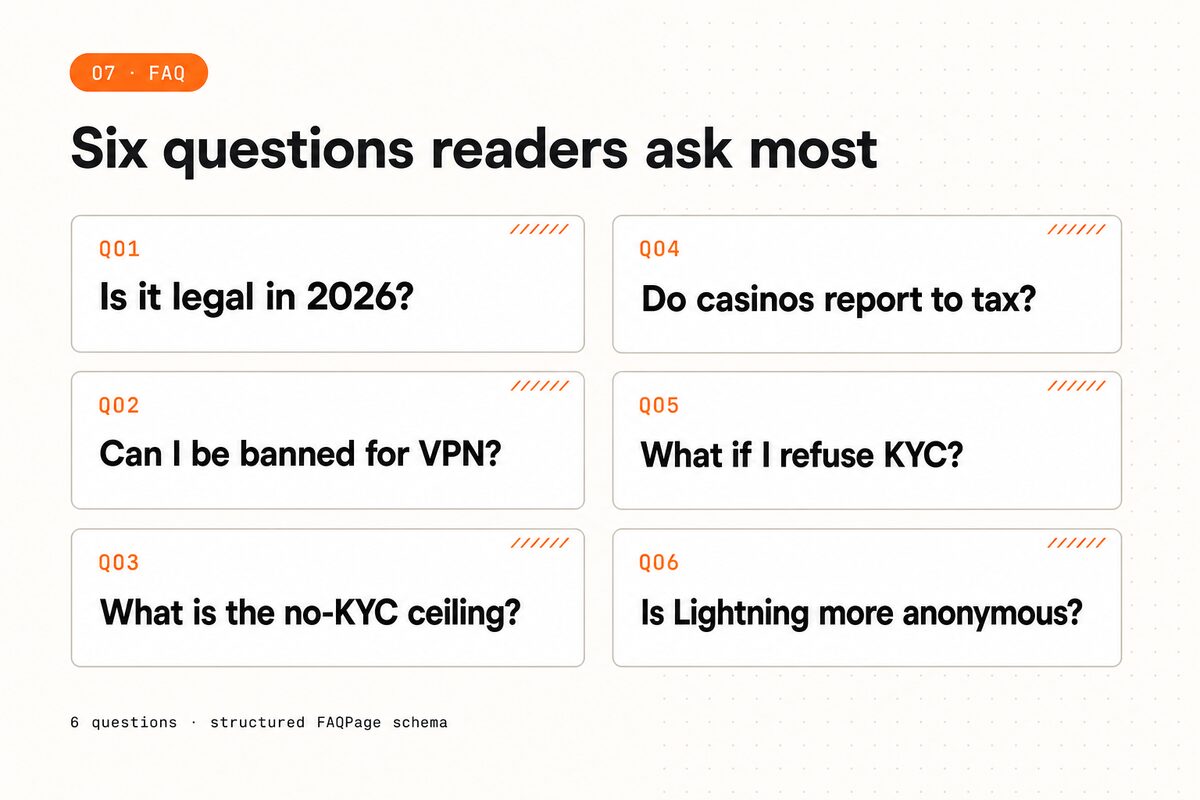
Is no-KYC crypto-casino gambling legal in 2026?
Yes, in most jurisdictions, with two important qualifiers. The legality belongs to the player's residence jurisdiction, not the operator's. Some jurisdictions (the United States outside specific licensed states, parts of the EU under MiCA, the UK under Gambling Commission rules, and others) restrict gambling at unlicensed operators regardless of KYC status. The second qualifier is tax: no-KYC withdrawals do not exempt the player from declaring winnings under whichever tax regime applies. See our dedicated crypto-gambling tax brief for jurisdiction-by-jurisdiction detail.
Can I be banned for using a VPN at a no-KYC casino?
Yes. The ToS at almost every operator in our audit reserves the right to close accounts that connect from prohibited jurisdictions, and the operator does not need to prove the player is physically located in one; IP evidence at signup is generally sufficient inside the operator's interpretation of the ToS. The defensible position is to use a VPN only if your residence is in a permitted jurisdiction and the VPN exit node is in the same jurisdiction, and to keep the exit node fixed across the entire account lifecycle.
What is the highest amount I can withdraw without KYC?
Operator-specific. Across our Top 8 ranked operators, the disclosed-threshold range sits between $20,000 equivalent and 2 BTC cumulative. Bitstarz publishes its threshold at 2 BTC, Cloudbet at roughly 1 BTC equivalent, and Cinoslots at a $20,000-equivalent mark. Below those thresholds you can expect a clean cash-out at the operators on this list, provided you respected the operational checklist above. Above them, expect KYC.
Do no-KYC casinos report player activity to tax authorities?
Generally no, and that is the operational definition of "no KYC". The operator does not hold identity documents and therefore cannot file information returns. However, this does not exempt the player from tax obligations in their residence jurisdiction. Your bank and the exchange where you off-ramp may file reports of their own, and tax authorities can subpoena operator records under mutual-legal-assistance frameworks if a specific investigation arises. Treat no-KYC as anonymity at the cashier, not anonymity at the tax authority.
What happens if I refuse KYC after the operator asks for it?
Almost always the funds freeze, the account is closed, and the balance is held pending verification. Several operators in our audit refund the original deposit minus a fee in this scenario; others convert the entire balance to "pending investigation" and hold it indefinitely. The recourse path depends on the licence: post-LOK Curaçao OGL routes complaints directly to the Curaçao Gaming Authority (the master-licence holder intermediary was retired in the December 2024 LOK reform) and Anjouan ALSI has an ADR step under its consumer-protection regulation. The methodology page details how our re-audit cycle tracks operator responsiveness to these escalations.
Are Lightning Network withdrawals more anonymous than on-chain Bitcoin?
At the network layer, yes: Lightning payments are off-chain and do not leave a permanent on-chain record at the channel level. At the operator layer, no: the casino still records the withdrawal request against your account, including timestamp, amount, and destination invoice. The compliance team sees the same internal ledger regardless of which network you used. Lightning improves on-chain privacy against external observers; it does not change anything about what the operator can later show a regulator.
What this means for your bankroll
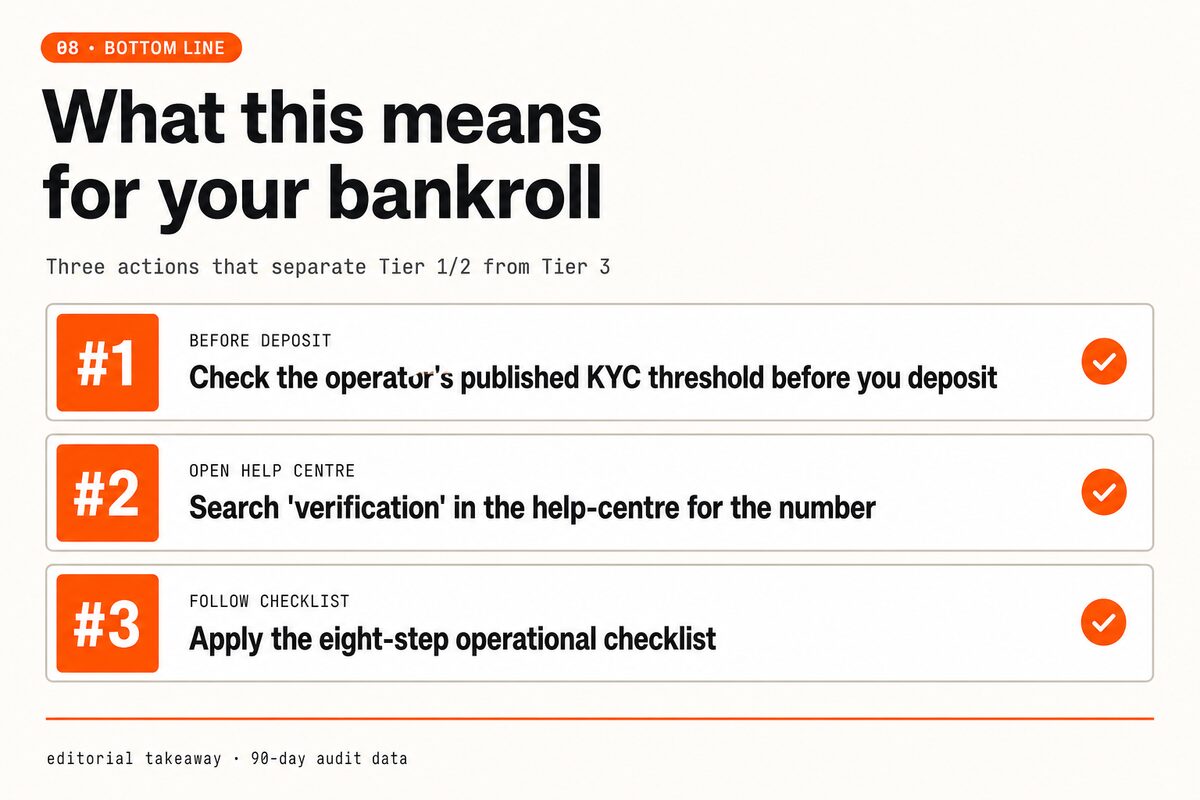
The thesis stands. True no-KYC is rare, conditional, and rules-driven. Five operators in our audit window honoured it cleanly inside a disclosed threshold; the other 50 either ran a hidden threshold, used a risk engine as a withdrawal-delay weapon, or appear on our public blacklist for one of the four trap patterns described above. 47 of those 50 are on the blacklist; the remaining three sit inside the published Top 8 ranking but failed our no-KYC test cleanly enough that we do not list them here.
The action item is mechanical. Before you deposit at any operator that markets itself as no-KYC, open the help centre, search for "verification" or "KYC", and find the threshold. If the operator publishes a number, you are dealing with Tier 1 or Tier 2 and the operational checklist will keep you below the trigger. If the operator does not publish a number, you are dealing with Tier 3 and you should plan on KYC being demanded the first time you try to withdraw a non-trivial balance. The bonus card on the homepage is not a binding compliance disclosure; the cashier T&Cs and the help-centre article are.
This article is the no-KYC entry point inside our editorial team knowledge base. The full criterion-by-criterion methodology, including how we test for hidden KYC thresholds against advertised ones, sits on the audit protocol page. The aggregate sample breakdown that backs every figure in this article (operator-by-operator transaction counts, per-network withdrawal medians, trap-pattern incidence rates) is published as the audit data summary.
This article was researched and written by the CryptoCasinoi Editorial Team under methodology v3.3, last revised 23 May 2026. All test data is drawn from the internal audit spreadsheet covering the February–May 2026 cycle. No compensation was received from any operator named above. Cinoslots is a disclosed editorial partner; the affiliate relationship is described in full in our affiliate disclosure.